
banner
Home Blog

The Complete Guide to Jaw Plates: 10 Essential Facts You Must Know

The Complete Guide to Jaw Plates: 10 Essential Facts You Must Know

Dec 08, 2025

In mining and construction, the Jaw Crusher is a cornerstone machine for primary size reduction. At the heart of its operation are the Jaw Plates – the critical, wear-resistant components that directly engage with and break down the material. This guide delves into everything you need to know about Jaw Plates, from types and materials to maximizing their lifespan and performance.


1. What is a Jaw Crusher?

A jaw crusher utilizes a fixed and a movable jaw plate to compress and fracture materials like rock, ore, and demolition debris. As the primary crusher in most circuits, it performs the essential first step of size reduction, preparing material for subsequent processing by cone or impact crushers.

Jaw Crusher


2. Where is a Jaw Crusher Used for

A jaw crusher is primarily used in the initial stage of the crushing process. It typically serves as the first crushing equipment in a crushing circuit, reducing raw materials from their initial size to smaller particle sizes. The main task of a jaw crusher is to compress and break down hard materials into sizes suitable for further processing, such as ores, rocks, minerals, stones, and construction debris.


Once raw materials have undergone the initial processing by a jaw crusher, they often move on to the next stage of crushing, such as a cone crusher or impact crusher, to further reduce particle size. Therefore, a jaw crusher plays a crucial role in industries like mining, construction, and quarrying, assisting in breaking down large chunks of raw materials into smaller segments for subsequent processing and production.


3. What Are Jaw Plates?

 Jaw Plates are the replaceable liners attached to the crusher's jaws. They serve a dual purpose: first, to efficiently crush material through compression; second, to act as a sacrificial shield, protecting the crusher's main body from wear and impact damage.

 Jaw Plates

4. The Role of Jaw Plates


Jaw plates serve a dual purpose. First, they facilitate the crushing process by compressing and breaking down the raw materials, reducing their size. Secondly, they act as guardians, shielding vital components of the jaw crusher from wear and damage.


5. Jaw Plate Profiles: Shape Dictates Application

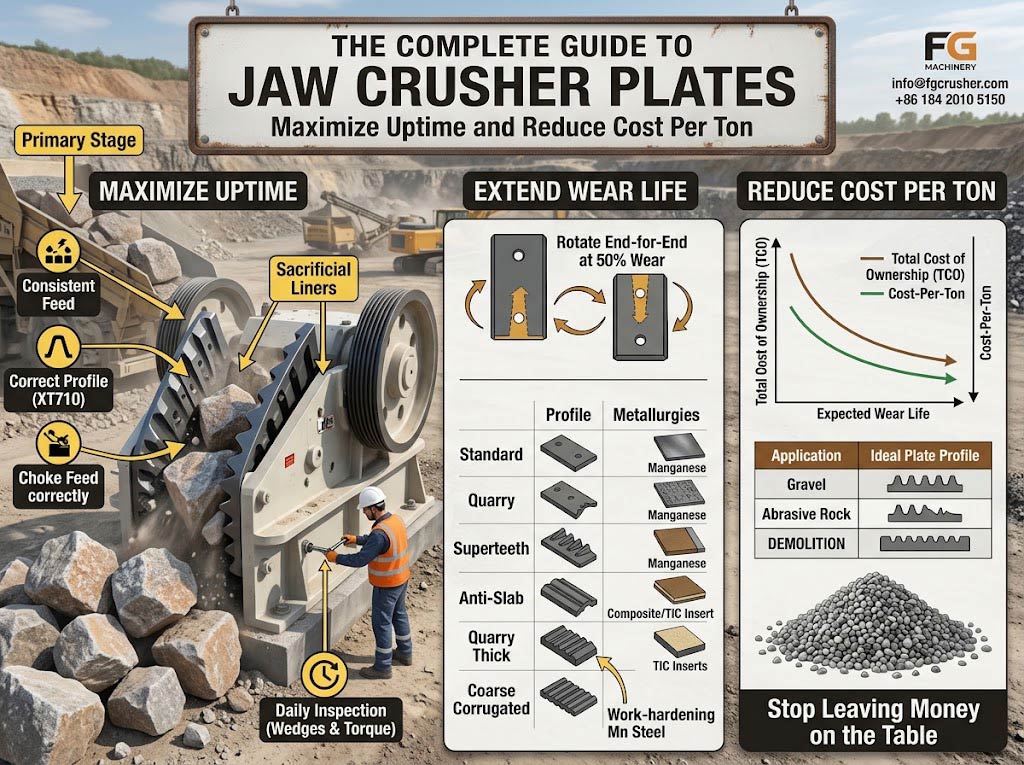
Standard (XT710) and Super Grip (XT710): Ideal for gravel and non-abrasive rock crushing, these types offer balanced power requirements and tooth spacing for fines removal, resulting in a less slabby product. However, they have a reduced lifetime in abrasive applications.

Quarry (XT710, MX*): Suitable for abrasive or blasted rock, these jaw plates feature a flat tooth profile for an extended lifetime, more wearable Mn-steel than standard jaws, and higher stresses and power requirements. Fines removal is crucial, but they may increase slabby products.

Superteeth (XT710): Suited for general use in gravel and blasted rock, these plates offer increased tooth contact surface area, more wear-resistant Mn-steel, and balanced power requirements, resulting in a less slabby product.

Quarry Thick (XT710, MX*): These jaw plates are excellent for abrasive and/or blasted rock, featuring a 40mm thicker fixed jaw die for a longer lifetime, a flat tooth profile, more wearable Mn-steel, and higher stresses and power requirements. Fines removal is vital, but they may increase slabby products.

Quarry + Super Grip (XT710): Designed for blasted rock, difficult natural rock, and slippery rock, these plates have a sharp tooth profile for a good grip on the rock, balanced power requirements, ideal tooth spacing for fines removal, and less slabby product.

Quarry Thick + Super Grip (XT710): Similar to the Quarry + Super Grip type but with a thicker fixed jaw die for longer lifetime and balanced power requirements, these plates are suitable for challenging rock conditions.

Anti-Slab (XT710, MX*): These jaw plates have an uneven tooth height to reduce slabs in the feed material, resulting in less slabby product.

Coarse Corrugated Jaws: Offering improved material flow, better wear life, enhanced product quality, and increased production compared to regular jaw plates. These jaws are suitable for various applications.

 6. Material Science: The Foundation of Durability

The choice of material is paramount to performance. Common options include:


Manganese Steel (Mn14, Mn18, Mn22): The industry standard, offering an excellent balance of high wear resistance and toughness through work-hardening.


High-Chrome Iron & Alloy Steel: Superior for extreme abrasion but may be more brittle.


Composite/TIC Insert Plates: Feature embedded tungsten carbide inserts for maximum wear resistance in the most demanding applications.


At FGMachinery, we provide expert material selection guidance and can customize jaw plate metallurgy to match your specific feed material and operational goals.


7. The 10-Point Checklist for Selecting Jaw Plates

Make an informed choice by evaluating these key factors:


Feed Material: Abrasiveness, hardness, and composition (e.g., granite vs. limestone).


Crusher Model & Specifications: Ensure perfect dimensional and mechanical compatibility.


Application: Primary crushing in a quarry differs from recycling concrete.


Profile Type: Choose the tooth design (see Point 5) that fits your material and product shape needs.


Desired Product Gradation: The plate profile influences output size and shape.


Operational Capacity: Ensure the plates support your target throughput.


Total Cost of Ownership: Balance initial price against expected wear life and cost-per-ton.


Ease of Replacement: Consider plate design and your maintenance setup.


Supplier Expertise & Support: Partner with a knowledgeable supplier like FGMachinery.


Historical Data & OEM Recommendations: Leverage past performance and manufacturer guidelines.


8. Why Jaw Plates Wear: 11 Key Causes

Understanding wear factors is the first step toward mitigation:


Highly abrasive feed material.


Improper or uneven feed distribution.


Crushing excessively hard or oversized material.


Incorrect crusher settings (e.g., closed-side setting too tight).


Misaligned jaw plates or poor installation.


Suboptimal plate material for the application.


"Sliding" wear in the discharge zone.


Feed containing too many fines, causing packing and abrasive grinding.


Lack of or improper dust suppression (water can be abrasive).


Harsh environmental conditions (corrosion, temperature).


Inadequate maintenance and lubrication.


9. Maximizing Jaw Plate Life: Proactive Strategies

Extend service life and optimize cost-per-ton with these practices:


Select Smartly: Use the checklist in Point 7.


Feed Correctly: Ensure consistent, well-sized material without tramp metal.


Operate Within Specs: Adhere to recommended speed and load limits.


Implement a Rotation Plan: For symmetrical plates, rotate or end-for-end them at ~50% and ~90% wear to utilize the full profile.


Inspect Regularly: Schedule checks for cracks, wear patterns, and tightness of fasteners.


Maintain the System: Proper lubrication of bearings and other components reduces stress.


Use Effective Dust Control: Opt for fine-spray systems to minimize abrasive dust without excess water.


10. Your Ultimate Partner for Jaw Plates: FGMachinery

Finding a reliable, expert supplier is the final critical factor. FGMachinery stands as your dedicated partner, offering:


Precision-Engineered Plates: Manufactured to exact OEM dimensions or custom specifications.


Advanced Material Options: From standard manganese to premium composites.


Technical Expertise: Our engineers help you select the optimal profile and material.


Proven Quality & Reliability: Consistent performance that maximizes your crusher's uptime.


Conclusion

Jaw Plates are far more than simple wear parts; they are the interface that defines your crusher's efficiency, product quality, and operating cost. By understanding their types, materials, selection criteria, and maintenance, you can make decisions that significantly boost your operation's productivity and profitability.


Ready to optimize your crushing performance? Contact FGMachinery today for expert consultation and premium jaw plate solutions tailored to your unique challenges.

Our Service
Our replacement parts provide durability and reliability equivalent to original equipment manufacturer (OEM) components but at significantly lower prices, tackling the high cost of genuine parts. Benefit from faster delivery and expert remote technical support from our Finland-based team. Choose FG Machinery to minimize downtime, maximize operational efficiency, and keep your mining equipment running at peak performance.

Emergency:

+8618420105150
Contact Us
Location Baiyun District, Guangzhou, China
Subscribe Newsletter
Subscribe Now +

Copyright © 2025 Guangzhou Future Green Machinery Co., Ltd. All Right Reserved. Network SupportedXML Privacy Policy

Guangzhou Future Green Machinery Co., Ltd.

facebook youtube

Leave A Message

Leave A Message
If you are interested in our products and want to know more details,please leave a message here,we will reply you as soon as we can.
submit

Home

SPARE PARTS

whatsApp

contact